Toto-Rex . totorex.ai . US & Canada edition Get the newsletter
Toto-Rex, professional headshot TOTO‑REXTMAI Compliance & Governance · US & Canada edition Subscribe
United States & Canada focus . federal, state, provincial, the agencies & the courts . AI compliance

Understand AI.
No technical background needed.

"Fifty states, fifty rulebooks. Luckily, dinosaurs have long memories."

— Regional Chief-Dino, US & Canada

Introducing Toto-Rex

A dinosaur lost his job to an algorithm, so he set out to understand it: the rules, the regulations, and just enough of the technology to follow them. Focused on the United States and Canada; the federal pivot, the fifty-state patchwork, the agencies and the courts, and Canada's privacy-led path; in plain English, from credible sources. Serious about the learning. Less serious about himself.

The newsletter is coming soon.

Toto-Rex at a laptop showing the word REJECTED
How it started

The algorithm came for the job. So he decided to understand it.

No technical background. No shortcuts. Just one word, one rule, and one small victory at a time, written down so you can walk the same path without the late nights and cold coffee.

This is that path, tidied up and shared. Welcome in.

02
Latest News

Hot off the wire, worldwide

The archive Toto-Rex's Weekly Summary

AI news from verified outlets; the United States and Canada first: federal, state, provincial, the agencies and the courts.

Toto-Rex's morning clippings . all the news that's fit to bite

The Cretaceous Courier

News of the day

California orders a study of an AI kill switch, reporting by 16 November

Executive Order N-9-26, signed on 18 September 2026, tells the Government Operations Agency, working with the Office of Emergency Services and national experts, to recommend by 16 November how state AI safety law should change. On the list: independent verification organisations auditing frontier developers on site, third-party checking of the safety frameworks and transparency reports those developers already file, wider reporting of loss-of-control incidents, and an emergency shutoff whose effectiveness is independently verified. Nothing is required of any company yet. The order is a two-month policy process, and Sacramento is where most frontier developers live, so its answer will travel.

Read the Governor’s release →
States
Illinois’ AI-in-hiring law takes effect
Illinois General Assembly . 1 January 2026

HB 3773 bars discriminatory hiring AI and ZIP-code proxies; on top of the state’s formidable biometric-privacy law.

Headlines link to their original outlets; the one-line gists are Toto-Rex's own. Curated 22 September 2026; check the source for the latest.

The shelf

Four folders, one tidy desk

Open a folder; the desk shows only what you need. Less scrolling, more finding.

The side rail and menus still reach everything; picking a link opens its folder for you.

01
The AI & Compliance Briefing

The reading that matters, in plain English

The archive Toto-Rex's Weekly Summary

Each item summarised by Toto-Rex, linked to its original source. US and Canada first: federal, state, provincial, the agencies and the courts.

Sort:

Region:
Level:
Level:

How this works: every summary is Toto-Rex's own plain-English take, and each card links out to its original source so you can read it yourself. Nothing is reproduced here. Educational only, not legal advice — for your own situation, ask a suitably qualified professional.

Sources, scope & limitations

Scope. This briefing covers AI compliance, regulation and policy for the United States and Canada — federal executive policy, the state patchwork, the sectoral agencies and the courts; and, for Canada, PIPEDA, Quebec's Law 25, the federal Directive on Automated Decision-Making and the Voluntary Code. The events radar (section 05, below) covers US, Canadian and online events from recognised hosts. It does not try to cover the EU, UK or Asia (see the sister editions), or sector rules that don't touch AI.

Sources. Credible, verifiable sources only: official texts (the Federal Register, NIST, state legislatures, court dockets), established US law firms, recognised legal press such as Bloomberg Law, and peer-reviewed academic journals. Every card links to its primary source.

Depth & timeline. Summaries are short by design; what a thing is and why it matters, then off you go to the original. Current as of 27 September 2026. There is no comprehensive federal AI statute; Texas's TRAIGA and California's SB 53 took effect 1 January 2026, and Colorado's replacement transparency law lands 1 January 2027.

Limitations. Toto-Rex is a dinosaur, not your lawyer. Summaries are his interpretation, they simplify, and the law moves fast; a federal preemption fight could yet reshape the whole map. Check the live source before you act, and take advice for your own circumstances.


02
The founder's & GC's desk

Ship nationally. Comply by state. Then cross the border.

Seven numbered stops, from an AI inventory to a running compliance calendar, then across the border into Canada; the fifty-state problem, made walkable. Each expands when you want the detail.

What this is: the path Toto-Rex actually walked to stand up an AI compliance program in the United States, in order; based on the official sources linked in each step, as at 1 July 2026. There is no federal AI statute to point at, so this is a program, not a form. Educational only, not legal advice — for your own setup, consult your lawyers.

  1. List everything. Every AI tool, model and feature in use; bought, built, or quietly switched on inside software you already license. You cannot govern a list you do not have.
  2. Classify by consequence. Flag anything that makes or shapes a consequential decision about a person; hiring, credit, housing, healthcare, insurance, education, essential services. Those carry the heaviest state duties.
  3. Name an owner for each. A human accountable for the tool, its purpose and its limits. The NIST framework's Govern function is mostly this.
  4. Record the data. What personal data goes in, where it is hosted, and whether the vendor trains on your inputs. This doubles as your privacy-law map.
  5. Keep it living. Re-run it quarterly; shadow AI multiplies between reviews.

Toto-Rex's note: one spreadsheet, one row per tool. If it isn't on the sheet, it doesn't exist; and if it decides something about a person, it gets a gold star and a lot more attention.

  1. Adopt the framework. The NIST AI Risk Management Framework and its Generative AI Profile. Free, sector-neutral, and the benchmark US agencies and states point back to.
  2. Do the four functions. Govern (accountability), Map (context and risk), Measure (test), Manage (act). Most of it is disciplined paperwork you will be glad to have.
  3. Bank the safe harbor. In Texas, substantial NIST compliance is an affirmative defence under TRAIGA; elsewhere it is evidence of reasonable care. Keep the records that prove it.
  4. Map to ISO/IEC 42001 if customers or investors want a certificate; the two line up cleanly.
  5. Ship with the GenAI Profile as a checklist for every generative feature.

Toto-Rex's note: it is a strange country where the most important rulebook is one nobody must follow. He follows it anyway; it is the closest thing to being presumptively fine.

  1. Follow your users, not your headquarters. A state's law reaches you if you serve its residents. Map where they are before you map anything else.
  2. Start with the big three. California's stack (SB 53, AB 2013, SB 243, the CPPA's ADMT rules), Colorado's transparency law (from 2027), and Texas's TRAIGA (in force). Get these right and most others follow.
  3. Add the specialists. Illinois BIPA (biometrics), NYC Local Law 144 (hiring audits), Tennessee's ELVIS Act (voice cloning), New York's RAISE Act (frontier models).
  4. Build to the strictest that reaches you. It usually covers the rest; and you ship once.
  5. Watch preemption. Washington may try to override state laws; until it actually does, they bind. Don't bet the business on a preemption that hasn't happened.

Toto-Rex's note: he keeps a US map with the states he serves shaded in. It looks like a weather chart. Some weeks it behaves like one.

  1. Pick up the state privacy laws. There is no federal one, so roughly twenty state statutes apply; the CCPA/CPRA in California first, then Virginia, Colorado, Connecticut and the rest. Sensitive data and profiling get extra rules.
  2. Respect automated-decision rights. The CPPA's ADMT rules give access and opt-out for significant automated decisions, phasing in from 2027; other states are following.
  3. Mind the sector laws. HIPAA (health), GLBA (finance), FERPA (education), COPPA (children) and the FCRA (background and credit scoring) all still bite.
  4. Disclose the machine. California and Utah require telling people when they are dealing with AI in certain contexts; synthetic-media and election rules vary by state.
  5. Get consent for biometrics and voice. Illinois BIPA (written consent) and Tennessee's ELVIS Act; treat these as the strict case nationwide.

Toto-Rex's note: he keeps a one-page privacy notice that actually matches what the tools do. The gap between the notice and the reality is exactly where the trouble lives.

  1. Consumer-facing? The FTC. Say only what your AI can actually do, and keep the evidence. A deceptive automated act is still a deceptive act under Section 5.
  2. Hiring? The EEOC. Title VII and the ADA bind hiring tools; test for disparate impact and keep the results; and run NYC's bias audit if you hire there.
  3. Lending? The CFPB. Specific, accurate adverse-action reasons under ECOA; the black box is no excuse.
  4. Health devices? The FDA. AI as a medical device: validation, human oversight and a predetermined change-control plan.
  5. Markets? The SEC. AI-washing in disclosures and conflicts in robo-advice are both on its radar.

Toto-Rex's note: ask which agency already regulates you. That is the one that regulates your AI now. The tool is new; the cop on the beat is not.

  1. Every quarter: refresh the AI inventory, re-run risk assessments, re-check vendor terms and data flows, and read your own privacy notice like a customer would.
  2. In force now: Texas TRAIGA and California's SB 53 / AB 2013 / SB 243 (since 1 January 2026); NYC hiring audits; Illinois hiring rules.
  3. Coming: Colorado's transparency law and New York's RAISE Act (both 1 January 2027), and the CPPA's automated-decision obligations (phasing from 2027).
  4. Serve the EU too? The EU AI Act's transparency duties from 2 August 2026 follow your product across the Atlantic.
  5. Watch the fight: the preemption push and the courts; a ruling, not a statute, may redraw the whole map.

Toto-Rex's note: he keeps the whole calendar on one page taped above the desk. Compliance is not a mood. It is a recurring appointment.

  1. Start from the gap: Canada has no AI statute. AIDA died on the order paper in January 2025 and was not revived; the June 2026 national strategy chose targeted reform instead. Do not build to a bill that no longer exists.
  2. Quebec first: Law 25 applies the moment you handle a Quebec resident's data. Tell people when a decision rests solely on automated processing; give the information used, the reasons and the principal factors on request; offer a route to human review. Penalties reach CAD 25 million or 4% of worldwide turnover, whichever is greater.
  3. PIPEDA everywhere else: meaningful consent, purpose limitation, access and correction. The fines are small, but the Privacy Commissioner publishes findings by name, and the regulators' joint 2023 generative-AI principles are how your model will be read.
  4. Selling to Ottawa? The Directive on Automated Decision-Making reaches you through your customer: an Algorithmic Impact Assessment before launch, then notice, explanation, human oversight and audit scaled to the impact level it scores.
  5. Banks, insurers, Ontario: OSFI's Guideline E-23 brings AI models inside federally regulated institutions under formal model-risk governance; Ontario's Bill 194 adds duties for public bodies. Expect their risk teams to ask for validation evidence.

Toto-Rex's note: if you already meet the EU AI Act and Colorado, Canada is a documentation exercise, not a rebuild. Map Law 25's automated-decision rights onto the explanation and appeal routes you built for the states, name a privacy officer for Quebec, and keep AIDA's ghost out of the roadmap.

How this guide is sourced

Sources. Every date and duty above links to its official source; the Federal Register, NIST, state legislatures, the federal agencies and court dockets; last updated 1 July 2026.

Scope. US AI compliance for a company operating across state lines. Not covered: company formation, tax, employment contracts, and anything bespoke to your situation. For the UK and EU, or Asia, see the sister editions.

Limitations. Toto-Rex is a dinosaur, not your lawyer. This is education, not advice; the law moves fast and the preemption fight could change the picture — always check the linked source, and consult your own professionals before acting.

Where do you stand?

Pick who you are; the duties and rights change with the seat you sit in.

You are the consumer the state laws were written for. Scope: your rights under state privacy and AI laws; they vary by state, and most cost nothing to use.

  1. Ask what they hold: California and a growing list of states give you access and deletion rights over your personal data. Send the request; it is free.
  2. Automated decision about you? California's ADMT rules (phasing in) and several state laws give notice and opt-out or human-review rights for significant automated decisions.
  3. Denied credit, a job or housing? You are owed reasons. ECOA for credit, and anti-discrimination law for hiring and housing, whatever tool was used.
  4. Biometrics? In Illinois, your faceprint or voiceprint cannot be taken without written consent; and you can sue directly under BIPA.
  5. Escalate in order: the company first, then your state Attorney General or the CPPA (California). For compensation, take advice.

Not legal advice. Rights and deadlines vary by state; for anything that matters, consult a lawyer or a legal-aid service.

You deploy other people's AI on your own staff and customers; and the accountability is yours, not the vendor's. Scope: state privacy and AI laws where your users are, plus your sector's agency rules.

  1. Inventory your AI (step 1); every tool touching people or decisions, with an owner against each.
  2. Check the vendor terms: do they train on your inputs? Where is the data hosted? Is there a data-processing agreement? No contract, no data.
  3. Lawful footing + notice: a privacy notice that matches reality, and AI disclosure wherever a state requires it.
  4. No quiet robo-decisions: significant automated decisions about people need notice and a human review under the emerging state rules.
  5. Test high-risk uses for bias — hiring, credit, housing; and keep the results. New York City requires the audit; the EEOC assumes the duty.

Not legal advice. A starting checklist, not a compliance program; size it with your lawyers.

You make the thing; developer duties follow the product across state lines. Scope: state AI statutes, federal agency law, and the EU AI Act if your system or its output reaches the EU.

  1. Know your training data's provenance. The fair-use cases turn on how you got it; never build on pirated corpora (see the notes).
  2. Publish what California asks: training-data documentation (AB 2013), and; for frontier models; a safety framework and incident reporting (SB 53; New York's RAISE Act from 2027).
  3. Build to NIST and keep the evidence — a Texas safe harbor, and elsewhere the measure of reasonable care.
  4. Disclosure by design: label AI interactions and synthetic media where states require it.
  5. Don't ship what you can't explain — to a regulator, a court, or the person it affects.

Not legal advice. Product classification and IP are exactly the questions to put to counsel early, in writing.

You process data or provide AI on other companies' instructions; cloud, SaaS, agencies, IT. Your customers push their duties down to you by contract. Scope: state privacy laws and your agreements.

  1. Expect a data-processing addendum: documented instructions, security, deletion at exit, audit rights. No contract, no processing.
  2. Stay in your lane: use customer data for your own purposes; say, training your models; and you take on the customer's duties too.
  3. Sub-processors need the same terms flowed down, and often the customer's approval.
  4. Security is your direct duty, and breaches go to your customer fast so their notification clocks can start.
  5. Selling AI? Expect a due-diligence questionnaire on data, testing and NIST alignment; have the answers ready before the buyer asks.

Not legal advice. Your contract terms are lawyer territory by definition.

You operate across state lines; which means several rulebooks at once. Scope: every state where your users are.

  1. Follow the users: a state's law reaches you if you serve its residents, headquarters notwithstanding.
  2. Build to the strictest state that reaches you (usually California) and you will cover most of the rest.
  3. Keep a live map: California, Colorado, Texas, New York, Illinois, Utah, Tennessee; plus the roughly twenty state privacy laws.
  4. One program, many overlays: a NIST backbone with state-specific add-ons beats fifty separate programs.
  5. Watch preemption: it could simplify everything or nothing; until it lands, comply state by state.

Not legal advice. Multi-state mapping is genuinely fiddly; one workshop with counsel saves ten incident calls.

Your customers or data cross borders. Scope: US state law, the EU AI Act and the EU GDPR, all at once.

  1. The AI Act follows the product: EU users mean EU duties (transparency since 2 August 2026; high-risk later), wherever your company sits.
  2. The GDPR reaches you directly if you offer goods or services to people in the EU; and you likely need an EU representative.
  3. Transatlantic data: use the EU–US Data Privacy Framework if your vendor is certified, or standard contractual clauses plus a transfer assessment.
  4. Map the overlaps: a NIST + ISO/IEC 42001 backbone travels well and satisfies much of both sides.
  5. Watch both weather systems: US preemption and EU simplification are each in motion.

Not legal advice. Cross-border scoping is precisely where specialist advice earns its fee.

One more time, because it matters: everything on this desk is education, not legal advice — laws change, they differ by state, and your facts are yours alone. Consult your lawyers before you act. Toto-Rex will still be here when you get back.

03
The application desk

What the machines are doing this week

Fresh AI uses in the wild; and the rule that walks in behind each one.

Editor's note . featured focus
Agents at large: when the software starts doing
Toto-Rex . 22 September 2026 . the focus rotates with the front page

This week's front page is about who gets to make the rules; the quieter story is what the software has started to do: browse, book, pay, file. An agent that acts is a different animal from a chatbot that talks; and existing US law already has a view. There is no federal AI statute, but an agent's click is your click: what it buys, you bought; what it promises, you promised. The FTC treats a deceptive automated act as a deceptive act, and the states' consumer laws agree. Toto-Rex's working rule: give an agent the least access it needs, log every step it takes, and keep a human hand on anything that moves money or people. Autonomy transfers work. It never transfers responsibility.

— T.R., from the study corner

How this note works: each morning Toto-Rex picks one focus from the front page (finance, health, agents, hiring) and writes its compliance angle in plain English. The focus rotates; the discipline doesn't. Educational only, never legal advice.

Assistants now complete multi-step tasks (browsing, form-filling, booking) through "computer use" controls. Marvellous, and also a liability surface, because an agent's click is your click. The rule that follows: least privilege, full logs, and human sign-off wherever money moves; and the FTC's deception standard does not care that a machine did it.

Anthropic's research notes

Stroke and chest X-ray triage tools are cleared and deployed across US hospital systems, flagging urgent cases in minutes; and the FDA's published list of AI-enabled medical devices now runs past a thousand entries. The rule that follows: the FDA regulates medical AI as a device wherever the software meets the definition (Software as a Medical Device), demanding validation, human oversight and a predetermined plan for how the model may change.

FDA · AI-enabled devices

Driverless taxis now run commercially in Phoenix, San Francisco and a growing list of cities. The rule that follows: there is no single federal robotaxi statute. NHTSA sets vehicle-safety standards while each state writes its own testing and deployment rules, so the law changes at every state line. Federalism, at 35 mph.

NHTSA · automated vehicles

Agentic coding tools now draft whole features. The productivity is real, and so are the new risks: license contamination, secrets pasted into prompts, unreviewed changes shipping to production. The rule that follows: keep human review in the merge path, and lean on the NIST framework and the CISA/NSA joint guidance for secure AI.

CISA · secure AI guidance

Applications change weekly; the desk keeps only what is verifiably deployed, linked to its official source. Educational only; not legal advice, and never a product endorsement.

04
AI & finance

Where the money meets the machine

Markets, funding and the rules that referee them; refreshed daily.

Money story of the day
The AI labs join the IPO queue
TechCrunch . June 2026 . public markets

OpenAI has confidentially filed for a stock-market listing, days after Anthropic's own move; the world's best-funded AI labs now want public money for the next generation of models and datacentres. For everyone else the prize is rarer than returns: quarterly disclosure. A listed lab must put revenue, risks and governance in writing where regulators, rivals and dinosaurs can read them.

Read it on TechCrunch

The defining money story of American AI is concrete and silicon: hundreds of billions in datacenter and chip commitments from OpenAI, Oracle, Microsoft, Google, Amazon and Meta. Capital expenditure, not model launches, is what shows up on the balance sheets; and the jobs, the power demand and the grid fights follow the money.

Reuters · AI

The Treasury's AI-in-financial-services framework translates the voluntary NIST AI Risk Management Framework into 230 concrete control objectives; the closest thing to a compliance checklist for banks, insurers and fintechs deploying AI. If you run AI in a regulated firm, this is your rulebook's front door.

US Treasury

No single AI statute for banks: US financial regulators supervise AI through the rules they already have; the CFPB on fair lending, the SEC on disclosure and robo-advice conflicts, and the banking agencies on model risk (the SR 11-7 guidance). Existing law, pointed squarely at new tools.

SEC · on AI

The CFPB's circular is blunt: if an AI model denies someone credit, the lender still owes specific, accurate reasons under the Equal Credit Opportunity Act. “The algorithm decided” is not one of the permitted reasons. Model inventories for US lenders begin here.

CFPB · circulars

Toto-Rex's standing reminder: this desk reports the money; it does not manage yours. Nothing here is investment, legal or tax advice — markets move faster than dinosaurs, so verify at the source and consult your own advisers.

05
Situations vacant

Hot AI jobs, pinned fresh daily

Where AI meets law, policy and product; straight from the boards that matter.

No. 1Federal & standardsAI standards & evaluation rolesUS Government · NIST / CAISI · Dept. of Commerce

The federal government hires AI minds for model evaluations, standards and procurement. Security-cleared dinosaurs welcome.

DC / hybridUSAJOBS
No. 2GovernanceAI Governance Lead (AIGP-track)Banks, insurers, health systems & consultancies

The fastest-growing compliance title of the decade: AI inventories, impact assessments, NIST programs and vendor triage. The IAPP's AIGP is the badge on the door.

US / remoteIAPP hub
No. 3State enforcementAI & privacy counsel, state AGsColorado, Texas, California & New York AG offices

The states are the front line, and their attorneys general are staffing up to write and enforce the new rules. Public-interest pay, front-row seat.

state capitalsNAAG
No. 4Research & frontier labsResearch, safety & policy at the labsOpenAI · Anthropic · Google DeepMind · and peers

The Bay Area and beyond: alignment, interpretability, policy and trust & safety; not just engineering.

SF / on-siteAnthropic careers
No. 5Legal professionAI counsel & legal engineeringAm Law firms & legal-tech teams

eDiscovery, AI governance practices, innovation counsel: the firms are staffing the workflows the book's Part IV describes.

US / hybridLawJobs
No. 6Assurance & auditAI auditors & assurance leadsBig Four, assurance firms & standards bodies

As NIST and ISO/IEC 42001 harden into audit criteria, someone has to test the controls. ISACA's AAIA is the emerging credential.

US / remoteISACA

Toto-Rex re-pins this board every morning from the official sources linked; postings, salaries and closing dates change daily, so always verify on the board itself. No placement fees, no affiliations; he just likes seeing dinosaurs employed.

06
Events radar

Get in the room where AI happens

AI summits, conferences and seminars from credible hosts; across the US, Canada and online.

Featured event
IAPP Global Privacy Summit
Washington, DC . spring, annual . the AI-governance profession's home game

If you leave the study corner for one thing this year, make it this. The IAPP Global Privacy Summit is the largest gathering of privacy and AI-governance professionals in the world, held in the city where American AI policy is actually written. Thousands of practitioners, regulators and general counsel fill the convention center; and AI governance now runs through nearly every session. If you want to see how the fifty-state patchwork and the federal agencies fit together, this is the room where it gets explained.

Why this one, and why you can trust it: Toto-Rex took no fee, no ticket and no commission to name it; it is simply the most useful and most credible AI-and-privacy gathering on the American calendar, and the AIGP credential was born from the same body. Read on for the full radar below.

Official site & registration
Where:
Sort:

Dates, venues and prices change; check them out yourselves before you go. Anything free is marked.

07
Toto-Rex's Notes . working drafts

Toto-Rex's notes, level by level

Real cases, real settlements, one fictional lake; and your rights at every turn.

Pick a level of the system. Each opens with one featured overview — Toto-Rex's plain-English summary of how that level governs AI; then notes on the real cases, laws and rules beneath it: what actually happened, what the rules say, what a company should never do, and what you can do about it. Every piece states its scope and links its sources, and none of it is legal advice.

Level:

How to read these: the cases, fines and dates are real and each note links its sources so you can verify them yourself; please do. The lake, Nessie and Colin are entirely fictional, and clearly labelled as such. None of this is legal advice, and it does not create any professional relationship; for your own situation, consult your lawyers. Based on the sources as at 7 July 2026; the law moves quickly.

The research library behind these notes

The library. These notes are the public face of Toto-Rex's AI Compliance Library; at version 6.1.1, 187 research documents (about 115,000 words): twelve deep jurisdiction packs (UK, EU, US, Singapore, Hong Kong, mainland China, India, Japan, South Korea, Brazil, Canada, Russia), an EU-27 implementation matrix, a US 50-state & D.C. index, a wider regional atlas, and the policy and evidence templates beneath them. Research cut-off: 13 July 2026.

How it is sourced. The English research edition records 431 unique official-source URLs across 1,160 citations and 2,610 internal links. The library is not re-cut every time this page changes: anything added after the cut-off carries its own last-updated date. Automated structural and citation checks are useful quality controls, but they are not legal or linguistic certification.

What it is not. The library's own label applies here too: general information and customisable templates — not legal advice or certification. English is the controlling edition; official legal texts and their authoritative language versions prevail.

08
Foundations, study paths & credentials

Learn enough to follow the rules

Just enough of the technology to understand the compliance. No coding required.

New . The Classroom . free e-learning

Proper courses now, taught the Toto-Rex way

Fourteen guided tracks from absolute beginner to specialist: step-by-step lessons, graded quizzes, four-depth study notes, flashcards; and a printable certificate when you pass. Every claim carries its source, and the dinosaur does the marking.

Certificates will be a paid option, launching soon.

Guided lessonsGraded quizzesStudy notes · 4 depthsFlashcardsCertificates
Enter the Classroom

Toto-Rex is not paid to feature any of these, and there are no affiliate links on this site. Listings point to each provider's official page; details, prices and dates change, so check before you enrol. Anything free is marked.

09
The AI dictionary

Featured word

One term, in plain English. No maths. No jargon.

Why it matters
The first real skill is knowing what it gets wrong.

Toto-Rex's note: always check what an AI tells you against a proper source. Especially names, numbers, and anything you would put your own name to. It is the cheapest insurance you will ever buy.

Toto-Rex . puzzles desk

The Daily Crossword

8–12 terms from the full glossary, refreshed daily. Ignore spaces and hyphens; letters only. Toto-Rex is watching. Supportively.

Across

    Down

      10
      Watch & listen

      Voices from across the AI world

      The archive Toto-Rex's Weekly Summary

      Talks, interviews and podcasts; builders, regulators, researchers and critics, in their own words.

      Clip of the day
      The growing backlash to AI's “race to replace” humans
      The Economist . YouTube, verified channel . June 2026

      Opposition to AI is starting to unite America's political left and right. Physicist Max Tegmark, chair of the Future of Life Institute, makes the case against racing to replace human work; a clear snapshot of the public mood regulators are now answering to.

      Watch on The Economist's channel
      Conversations worth your time . podcasts & interviews with high-stakes AI players
      The two guests every AI panel somehow ends up booking: Somebody, and Nobody.

      These are external shows Toto-Rex rates. Links go to each show's official page; specific episodes come and go, so browse for the guest you want.

      11
      The toolbox

      Popular AI tools, by what they do

      Toto-Rex wants to try them all. Forgive him; he's a dinosaur, picking it up bone by bone.

      Grouped by job. Listings link to each tool's official site; none of it is paid placement, and most have a free tier.

      12
      Regional expert dossier · English source edition

      United States & Canada deep analysis

      Rights, duties, penalties, dated agenda, operational practice and cross-border reach.

      The two expert dossiers most relevant to this edition, the United States and Canada, are available here in compact English form. The interactive globe, all fourteen jurisdictions, treaties, comparative models and industry tracker remain in the Global edition.

      Open the full Global atlas

      13
      From the study corner to the shelf

      The book is coming

      Everything this site teaches, bound, sourced and indexed.

      Maqutt Publishing · London
      AI Compliance
      in the USAn Introduction
      EW
      Toto-Rex's neighbour
      IAPP AIGP · CIPM
      Microsoft Azure AI Engineer (AI-102) · AWS Machine Learning
      Google Cloud Generative AI · MIT Sloan, AI & Strategy

      AI has arrived faster than the law that governs it; and in America that gap is filled not by one statute but by four forces at once: the White House, the states, the agencies and the courts. The book strips away the maths, the hype and the fear: federal policy, the fifty-state patchwork, the NIST framework and the copyright fights, in plain English, built around a practical six-factor framework you can run on any AI system; five factors that follow its life, and a sixth you hold against them all. Written for founders, general counsel, educators, regulators and the professionally curious.

      • What AI actually is, and how it works, in plain English
      • The federal pivot, the fifty-state patchwork, and where they collide
      • NIST, the agencies, and the fight over who gets to regulate
      • The copyright cases and how the legal profession really uses AI
      • The six-factor framework for assessing any AI system

      "A working machine asks: who answers for me?". Like everything in the study corner, the book is education, not legal advice. It sets out the law, cases, news and studies as at September 2026, reminds you to check them against the primary sources, and then tells you what the current situation is.

      The newsletter

      AI, explained for normal people.

      A monthly-ish letter; he aims for once a month, study schedule permitting, and would rather skip an issue than send you filler. Toto-Rex writes it himself, between study sessions and waiting on deliveries. The developments that matter, what the new rules mean, and one tool worth a look. Plain English, no jargon, no commitment.

      Sign-up opens soon.

      Toto-Rex in a bowler hat raising a glass

      Cheers. See you next month. Probably.

      14
      In your pocket

      Toto-Rex, going mobile

      The real thing is still in the workshop.

      Toto-Rex is coming to phones. The waitlist opens soon.

      15
      Toto-Rex originals

      Learning, the Toto-Rex way

      Short films, songs about AI and honest tool tests; serious learning, carried lightly.

      Meet Toto-Rex . two short films
      Swipe for more →
      Songs about AI . and more to come
      Swipe for more →
      For real

      What the Toto-Rex team has studied

      • AI Governance (AIGP, IAPP)2025
      • Privacy Programme Management (CIPM, IAPP)2025
      • Data Protection (CIPP/E, IAPP)2025
      • Data Protection, Asia (CIPP/A, IAPP)2025
      • BCS Practitioner Certificate in Data Protection2025
      • Microsoft Azure AI Engineer (AI-102)2025
      • Microsoft Azure AI Fundamentals (AI-900)2025
      • Microsoft Power BI Data Analyst (PL-300)2025
      • AWS AI Practitioner (AIF-C01)2025
      • AWS Machine Learning2025
      • Google Cloud Generative AI2025
      • MIT Sloan, AI & Strategy2025

      No technical degree here, and no rush; just one exam at a time. All the new AI can feel overwhelming, and a touch of FOMO is only natural, but once you know what you're aiming for, it's far easier to find your way through. Your pace, your path.

      “Who says a T-rex can't reach their toes?” — Toto-Rex, stretching

      Toto-Rex's Corner

      The bit that will not help your career

      Everything above is the serious stuff. This is the cherry on top: useless facts, small joys, and a dinosaur with opinions.

      He told everyone the "T" in T-Rex stands for Technology. We both know it stands for Tyrannosaurus.

      Swipe for more →
      Dino of the day
      Pachycephalosaurus

      A 25 cm dome of solid bone on its head, evolved for headbutting rivals. And, Toto-Rex suspects, recruitment software.

      Late Cretaceous . "thick-headed lizard"
      Useless fact
      200 million years

      Roughly how long his lineage survived. He still cannot get a CV past an automated screening filter.

      Evolution: undefeated. Recruitment: also undefeated.
      Quote of the day
      “I'm not behind. I'm pacing myself across 200 million years.”

      A healthy attitude to a backlog, or a coping mechanism. Possibly both.

      Toto-Rex, on his learning speed
      Celebrity crush
      Nessie's granddaughter

      Of the Scottish Highlands. Also named Nessie, she runs a flourishing marketing company on the shores of Loch Ness; and is entirely out of his league, which, he notes, has never stopped anyone on a dating app.

      Takes client calls from the loch. Her grandmother is very proud.
      Love–hate relationship
      The flying reptiles of South Kensington

      Distant relations, technically. They hang about a certain museum looking down on everyone, and they haven't kept up with a single development since the Cretaceous. He visits anyway. Family is family.

      They are not even dinosaurs. He has told them this. Repeatedly.
      His dating profile
      The way to my heartA tidy spreadsheet and properly cited sources.
      Looking forSomeone who thinks resitting an exam shows commitment, not a red flag.

      16
      Before you go

      AI may take the job. It cannot take you.

      The one thing on this site that is not negotiable.

      A machine can draft, sort, total and summarise. It cannot care, keep a promise, own a mistake, or read a room. That part of the work was never in the job description. It was always you.

      So learn the tools and mind the rules. Then bring what no model can produce: taste, judgement, kindness, and the nerve to ask the obvious question.

      “Whatever the algorithm decides, you've got me, buddy.”

      Toto-Rex

      “The difference between AI and a person is that a person can feel pain. Then again, what would I know? I’m just a dino boy who eats fish.”

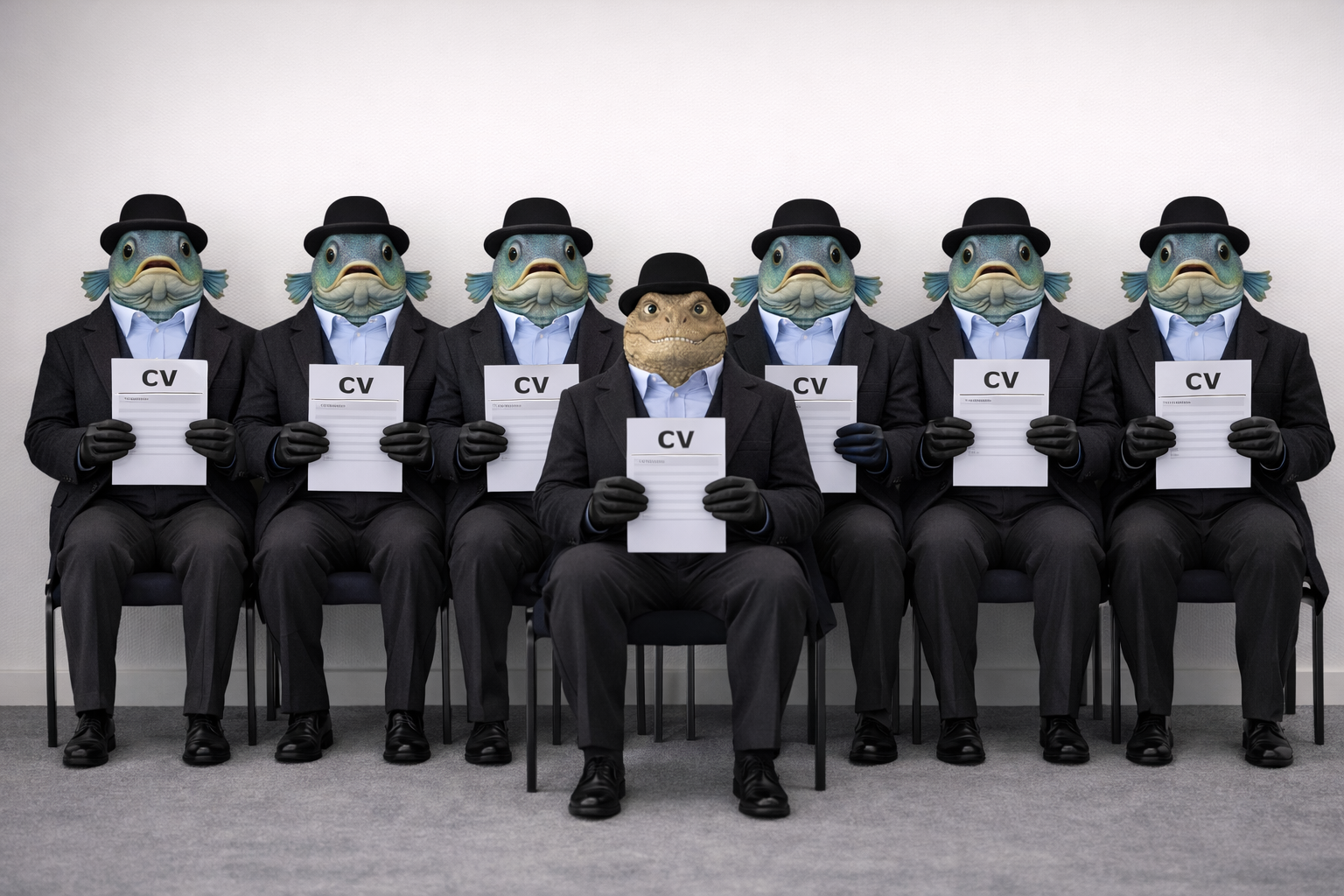
      Toto-Rex holding his CV in a row of identical fish-headed candidates
      Seven identical CVs. One original. Be the original.
      17
      Rex for relax

      Fancy a game?

      Step away from the syllabus. The dinosaur plays a patient game.

      The Cretaceous Chess Club · established a very long time ago

      Fancy a Game?

      Your move.
      Tap to dismiss
      18
      Say hello

      Write to Toto-Rex

      He reads more than he lets on.

      Toto-Rex in his bowler hat and coat

      He may or may not read this. He is usually studying, or waiting on a delivery. But he reads more than he lets on, and he appreciates you stopping by.

      The postbox opens soon.

      Toto-Rex can make mistakes. Everything here is general information, not legal advice: check the primary source, and take advice from a qualified professional before you act.